Craft · Oak Buck Journal
The beauty of hand stitching.
Two needles. One length of thread. Time spent on the seam you carry every day.
The Oak Buck approach
Quality takes time.
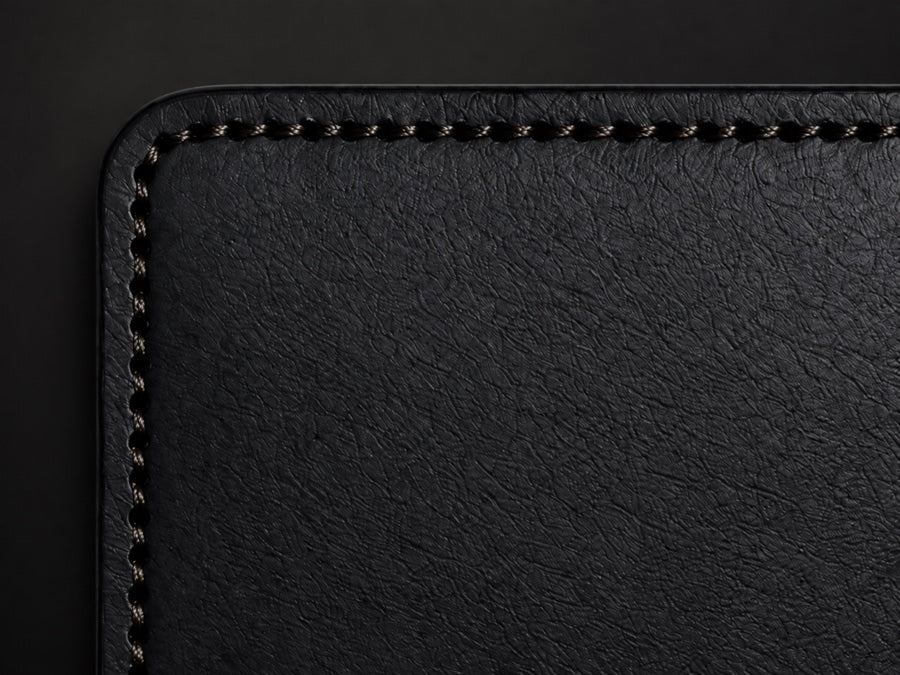
The outline of a wallet is drawn as much by its stitching as by its cut. Spacing, tension, and the turn around a corner all contribute to how the finished piece feels and looks.
We sew Oak Buck wallets by hand using saddle stitching. Hand sewing sacrifices time and speed for the sake of quality: it gives us the opportunity to place, tension, and inspect each stitch as we work. That attention suits our small batches and the defined profile of The First Mark.
How it is made
Two needles, working together.
A saddle stitch uses a needle at each end of one continuous length of thread. Both needles pass through each prepared hole from opposite sides. The maker draws the thread through and sets the tension before moving to the next hole.
The rhythm is deliberate. Hole placement establishes the line; thread tension brings the layers together. Consistency comes from repeating those movements carefully, especially where the thickness changes or the seam turns a corner.
It is a practical construction method with a distinctive visual rhythm. The workmanship still matters: simply being sewn by hand does not make a seam well made.
A closer look
Three ways to build a seam.
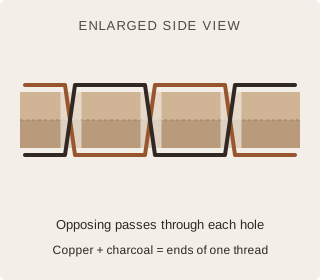
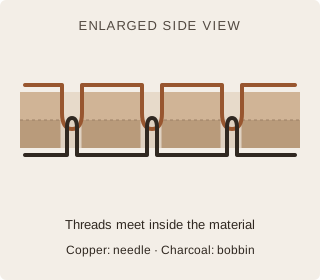
These simplified formation diagrams explain the difference. They show the working elements, rather than an exact cross-section or a strength ranking.
Hand saddle stitch
Machine lockstitch · 301
Machine chainstitch · 401
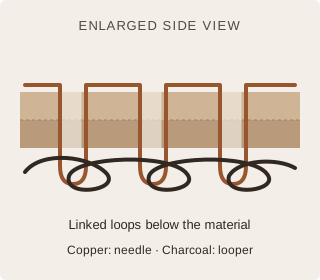
| Method | What it offers | The tradeoff |
|---|---|---|
| Hand saddle stitch | Individual control over placement and tension. | Slower production; depends on the maker’s consistency. |
| 301 lockstitch | A strong, compact seam with a similar appearance on both sides. | Limited stretch and periodic bobbin changes. |
| 401 chainstitch | Higher production speed and greater seam stretch. | A bulkier underside; can run back if the chain is unsecured. |
| 304 zigzag lockstitch | A sideways stitch pattern accommodates more movement. | A different visual line from the straight seam chosen for OB-01. |
Chainstitch and zigzag are included to explain the wider range of machine seams, not to suggest they are used in every machine-sewn wallet. A walking-foot machine describes how material is fed; it does not name a separate stitch structure.
Beyond the sales claim
What if a stitch breaks?
A damaged thread is a reason to inspect a seam. It is too simple to claim that every machine seam immediately unravels, or that a saddle-stitched seam cannot fail. The stitch formation, thread, tension, hole spacing, leather, and how the ends are secured all affect what happens next.
For the owner, the useful action is the same: if you notice a loose or broken stitch, stop pulling at it and contact us with a photograph. We can assess the piece and advise on the next step under our Lifetime Warranty.
Why we choose it
Attention in every pass.
Our reason for saddle stitching is grounded in the way we want to make things. Working in small batches allows us to stay close to the material and give the seam the same attention as the leather selection and the shape of the wallet.
Look closely at OB-01 and you will see the stitching follow the exterior, frame the pockets, and turn around its edges. It is part of the design, and part of the work behind it.
Explore the making of OB-01Further reading
Stitch terminology and machine comparisons: Coats — Basic Stitch Types. Two-needle technique: Tandy Leather — Saddle Stitching.
Continue with Why We Use Full-Grain Leather or return to the Journal.